No Heat in Calgary? Four Checks, Then One Call
Check four things in this order: the thermostat is on heat and set above the room temperature; the furnace switch (it looks like a light switch, near the furnace or at the top of the basement stairs) is on; the breaker has not tripped; and the filter is not choked. If all four are fine, call HVAC Lines at (825) 395-7447 — our assistant confirms the fault and your postal code and puts you through, still on the line, to a furnace repair technician from our network who has agreed in writing to hold the licences Alberta requires.
This page is for two people: the one whose furnace has just stopped on a Calgary winter night, and the one who wants to know what to do before that happens. The first should read the four checks above, look at the “call now” list, and phone. The second can read the rest — how quickly a house here loses heat at −25 °C, why the city's high-efficiency furnaces fail in deep cold specifically, the common furnace problems behind a no-heat night, what an emergency furnace repair in Calgary typically costs and when morning furnace repair costs less, what a tenant is owed under Alberta's housing standard, and how to keep the pipes safe while you wait.
One rule sits above everything else on this page. If you smell gas, or a carbon monoxide alarm has gone off, none of the checks apply: leave the house first, and call ATCO Gas or 911 from outside before you call anyone about a furnace.
What to do, in order
Thermostat
Mode set to heat, temperature set at least 3 °C above what the room reads, fan set to auto. If it has batteries, change them — a dying thermostat battery is a surprisingly common “dead furnace” in Calgary's older split-levels, where the thermostat is the only thing between you and the furnace.
The furnace switch
A plain light switch on the wall beside the furnace or mounted on its side, usually unlabelled. In many older Calgary basements it is at the top of the stairs, where a hand feeling for the light finds it first. Make sure it is on. Then check the front panel is seated — most furnaces will not run with the door off.
The breaker
Find the furnace's breaker in the panel and reset it once. If it trips again straight away, stop — that is an electrical fault, not a nuisance trip, and resetting it repeatedly is how a small problem becomes a fire.
The filter
Slide it out and hold it up to a light. If you cannot see light through it, the furnace has probably shut itself down on its limit switch to avoid overheating. Put in a fresh one, wait ten minutes for the furnace to cool, and try again.
Outside: the vents
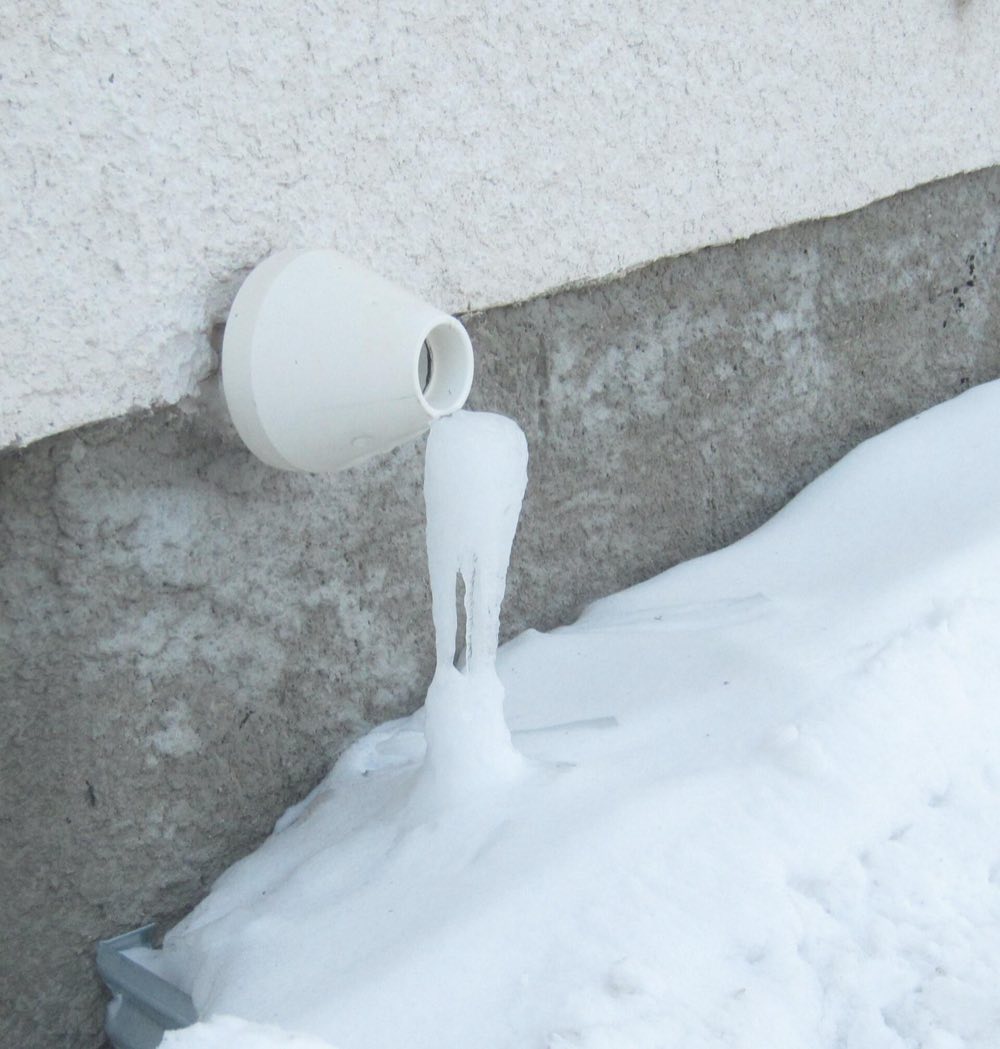
A high-efficiency furnace breathes through two white PVC pipes on an outside wall. At −30 °C the exhaust moisture can ice the end shut, and a drift off the roof can bury both. Clear them by hand. Never pour hot water on them.
Call
Our assistant asks what the furnace does when it tries to start, your postal code and whether it is a home or a business, then transfers you live to a technician from our network who is available now. Have the make of the furnace and the thermostat reading ready. If nobody can take the call at that moment, you are told so on the call — not left waiting.
Call a professional immediately if…
- You smell gas at any point. Leave first, then call ATCO Gas at 1-800-511-3447 from outside.
- A carbon monoxide alarm sounds, or anyone has a headache, dizziness or nausea that eases outdoors. Leave and call 911.
- The indoor temperature is heading for single digits, or it is below −20 °C outside — the pipes in the outside walls are now the emergency.
- Someone at home is elderly, unwell, pregnant or very young.
- The breaker trips a second time, there is scorching or soot on the furnace, or it bangs on start-up.
What happens once you call
The technician diagnoses in person and quotes before doing anything; most first-visit furnace repairs — igniter, sensor, pressure switch, a frozen condensate line — are done on the spot. Emergency furnace repair is available around the clock in Calgary through the network, and the technician quotes at their rate, not ours.
If the furnace is past fifteen winters and the fault is a heat exchanger, a control board or a blower, expect the repair-or-replace conversation. A cracked heat exchanger ends it: the furnace is red-tagged and shut off, and the technician you are speaking to should hold an Alberta gasfitter certificate, Class B or Class A to say so. If replacement is the answer in a cold snap, the furnace installation page covers what to ask.
How long a Calgary house holds its heat
A reasonably insulated house at −25 °C outside loses roughly one to two degrees an hour once the furnace stops — faster in a 1960s bungalow with single-pane basement windows, slower in a tight 2015 build in Airdrie with the blinds down. From a normal 21 °C that is most of a night before the house is genuinely uncomfortable, and a day or more before anything freezes in a well-built home. In a chinook week, with +8 °C outside, a house barely drops at all and the whole thing can wait for morning.
The number that matters is not the room temperature but the temperature inside the outside walls, where the plumbing runs. Kitchens and bathrooms on exterior walls, the hose bibs, and the pipes in an unheated crawl space or garage-side wall are the first to freeze, and they do it while the living room still reads 14 °C.
- Keep interior doors open so heat moves through the house; close blinds and curtains at night.
- Open the cabinet doors under any sink on an outside wall so room air reaches the pipes.
- Let the taps on outside-wall plumbing run at a trickle — moving water freezes far more slowly.
- Run the oven or stove for warmth only if the house is not gas-alarmed; never bring a barbecue, camp stove or patio heater indoors.
- Plug electric space heaters into separate circuits and keep them a metre from anything that burns. They hold a room, not a house.
- If you leave the house, do not set the thermostat below about 13 °C, and shut off the main water valve if you will be gone more than a night.
Why furnaces here fail in the deepest cold
Nearly every furnace in Calgary is a high-efficiency condensing unit — that is all that has been sold in Alberta for years. They are excellent machines with two habits that only show in deep cold. First, they vent through a wall rather than a chimney, and at −30 °C the moisture in the exhaust can freeze the termination shut; the pressure switch then refuses to let the burner fire. Second, they produce litres of acidic condensate a day, and a drain line routed through an unheated corner can freeze solid, backing water up until a float switch shuts the furnace down.
Add the ordinary wear parts — an igniter that has been cracking since spring, a flame sensor filmed over after a chinook week of short runs, a capacitor that is weak but has been getting by — and the first night the burner is asked to run for hours without stopping is the night one of them gives up. That is why furnace repair calls come in waves, and why the technician you reach at 2 a.m. in January is likely to have seen your exact furnace problem twice already that night. Most of them would have been caught by a September furnace tune-up.
The chinook version
Calgary is the only big city in the country where a furnace can go from running eight hours a day to eight minutes a day and back within seventy-two hours. Short, warm-afternoon cycles let oxide build on the sensor that proves the flame; the return of cold that night is when the control board cannot see a flame and locks out. If your furnace fails the first cold night after a chinook, this is the first thing to suspect — and it is one of the cheapest furnace repairs there is.
What an emergency furnace repair costs in Calgary
Knowing the rough furnace repair figure at 2 a.m. tells you whether waiting for business hours is worth it. We do not set these prices — the technician quotes you before starting, and the quote depends on the part, the furnace's age and brand, and how hard the part is to reach. A typical initial visit in business hours runs about $89–$150, and any Calgary furnace repair company should confirm the after-hours figure before leaving the shop. These are the published Calgary-area ranges.
When morning costs less
Overnight and holiday rates commonly run 25–100% above standard. If the house is holding above about 15 °C, nothing smells of gas, no alarm has sounded and nobody at home is vulnerable, a furnace that is merely noisy, cycling oddly or weak can usually wait for 8 a.m. furnace repair — and a decent technician will tell you so on the phone. A furnace that is silent in a −30 °C snap cannot. Either way, the furnace repair page covers what each fault costs in daylight.
| Job | Typical Calgary-area range | Notes |
|---|---|---|
| Diagnostic, business hours | $89–$150 | Usually credited toward the repair if you approve it same visit |
| After-hours or emergency call-out | $150–$300 | Overnight and holiday rates commonly run 25–100% above standard |
| Igniter, flame sensor or capacitor | $150–$350 | The most common no-heat causes, and the cheapest to fix |
| Control board or gas valve | $300–$900 | Part alone is often $200–$600 before labour |
| Blower motor | $400–$800 | A variable-speed ECM motor sits at the top of the range |
Carbon monoxide: the reason to leave first and diagnose later
A furnace that is misbehaving is the commonest source of carbon monoxide in a Canadian home. In a Calgary house sealed tight against the cold, a cracked heat exchanger or a blocked flue puts the gas exactly where people are sleeping, and CO has no smell and no colour — the alarm is the only warning you will get.
The symptoms read as flu without the fever: headache, dizziness, nausea, confusion, unusual tiredness. Two things give it away — the symptoms ease when you go outside and return when you come back in, and more than one person, or a pet, is affected at the same time.
Alberta's building code requires a carbon monoxide alarm in any home with a fuel-burning appliance or an attached garage, inside or within five metres of each bedroom. The night the furnace starts acting up is the night to press the test button on every alarm in the house.
If you rent: heat is the landlord's responsibility
Worth knowing before you pay for an after-hours visit out of your own pocket. Under Alberta's Residential Tenancies Act a landlord must keep the premises habitable, and habitable means meeting the province's Minimum Housing and Health Standards — which include working heat.
Alberta's Minimum Housing and Health Standards, made under the Public Health Act, require a heating system in good repair that can hold 22°C in every living space, and at least 16°C through the coldest stretches. Calgary sets no bylaw season for it: the standard applies whenever it is cold enough to matter, and it applies to the unit's own heating, not only the building's. A unit that cannot reach that is below the standard, and the landlord is responsible for putting it right.
The practical steps: tell the landlord or property manager in writing — a text is fine — with the time and the indoor temperature, and keep the message. If nothing happens, Alberta Health Services' Environmental Public Health inspectors enforce the standard, and Health Link at 811 will put you through to one. If it is genuinely cold and nobody is answering, do not sit in a freezing unit for the sake of the process; keep the record, because it is what gets the cost back.
Questions
My furnace is dead but the house is still warm. Should I wait until morning?
If it is above about 15 °C indoors, nothing smells of gas and nobody at home is vulnerable, you can — but call early rather than late. A Calgary house at −25 °C loses one to two degrees an hour, faster in an older bungalow, and the pipes in outside walls freeze before the rooms feel cold. You have more choice of technician at 7 p.m. than at 3 a.m.
The furnace fan is running but the air is cold. What is wrong?
Either the thermostat's fan setting has been knocked to “on”, or the furnace has locked out after failing to light and is running the blower for safety. Set the fan to auto. If it keeps blowing cold, the furnace has locked out — usually an igniter or flame sensor — and needs a technician. Change the filter while you wait.
Why does my furnace keep starting and stopping?
Short cycling. Most often a filmed flame sensor — common after a chinook week of short runs — or a blocked filter overheating the furnace so its limit switch opens. Both are quick fixes. A restricted flue does the same thing and is a safety matter, so if the furnace also smells hot or sooty, call rather than wait.
Is a −30 °C night different for the furnace?
Yes. High-efficiency furnaces vent through a wall and drain condensate; at −30 °C the vent can ice shut and the drain can freeze, and either shuts the furnace down. The burner also runs for hours without a rest, which is when a tired igniter or capacitor finally fails. Clear the outside vents by hand before you call.
What if my landlord will not fix the heat?
Put it in writing with the time and the indoor temperature, keep every message, and escalate if nothing happens: Alberta Health Services' Environmental Public Health inspectors enforce the standard, and Health Link at 811 will put you through to one. If the unit is genuinely cold, do not wait on the process — get warm first, and keep the paper trail that gets the cost back.
Do you repair furnaces yourselves?
No. hvaclines.ca is a live call-connection service run by PatchLead. We confirm the fault and where you are, then connect you on the same call to an independent technician from our network who does the work and quotes you directly. You pay nothing to use the service.